
Stratford Town Criminal Court Cases
Stratford has no county government, county clerk, county sheriff, or municipal criminal court. Criminal and motor-vehicle matters from town enter the Connecticut Superior Court, the state's general trial court. The usual venue is Geographical Area No. 2 in Bridgeport. More serious matters may proceed at the Fairfield Judicial District courthouse. Venue can change as a case develops, so the defendant name and docket number are safer guides than a guess based on the arrest location.
The Superior Court clerk keeps the judicial file. Stratford Police keeps the incident and arrest report, while DESPP/SPBI maintains the separate state criminal-history repository. These records overlap, but none substitutes for another. The court docket is the best source for the charge actually filed, the plea, each public event, the final disposition, and the sentence.
Stratford Cases at Bridgeport G.A. 2
The official G.A. No. 2 courthouse page identifies 172 Golden Hill Street, Bridgeport, as Stratford's practical criminal courthouse. Court hours are 9:00 a.m. to 5:00 p.m., with doors opening at 8:30 a.m. The Chief Clerk line is 203-579-6568, and the clerk's public information and records line is 203-579-6560. Calling first can confirm the docket location, copy procedure, and whether a file must be retrieved.
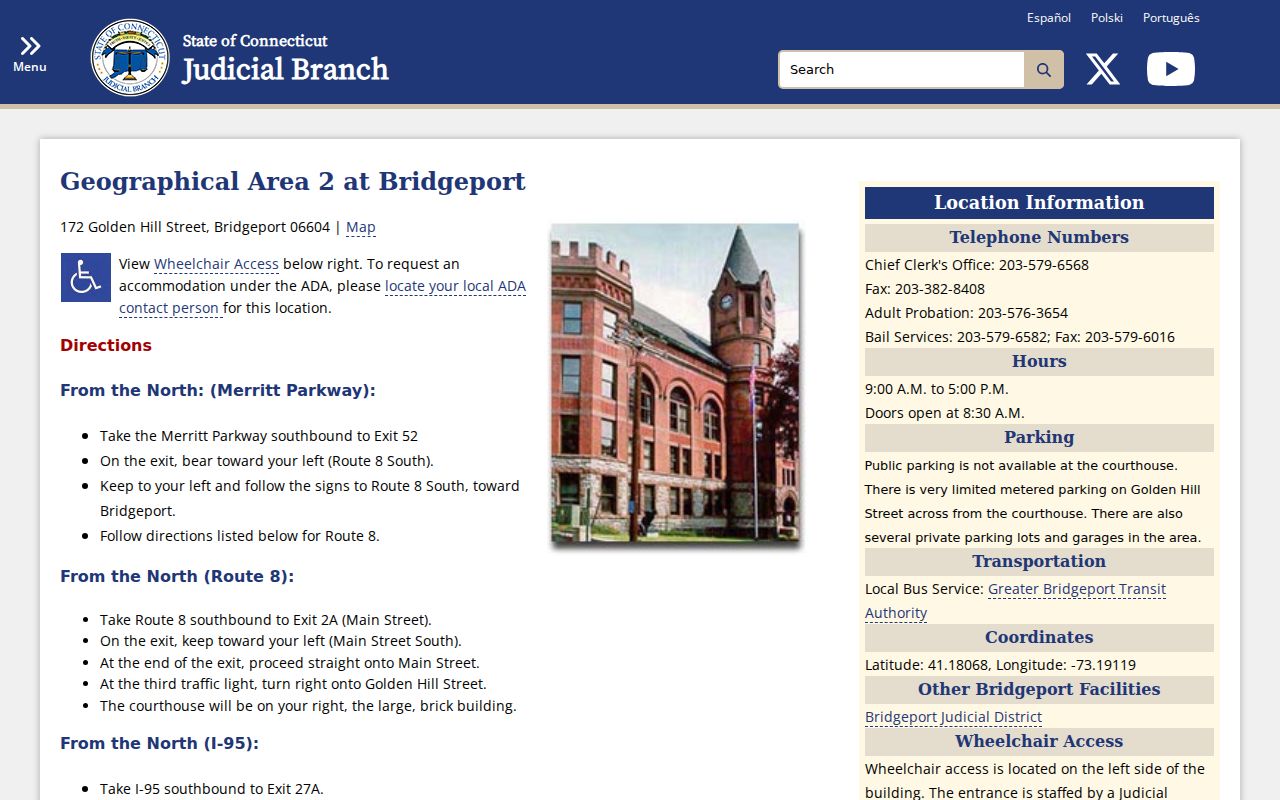
The courthouse image ties the court directory to the office that holds most Stratford criminal dockets. Its first-floor Public Information Desk provides calendar and docket help, electronic lookup, a public-access computer, forms, language help, and staff assistance. Stratford Town Hall cannot issue a Superior Court disposition.
When a case has moved beyond the geographical-area docket, check the Fairfield Judicial District venue at 1061 Main Street in Bridgeport. Its Court Service Center can assist with forms and public court resources. The two Bridgeport locations are part of one state system, not separate county courts. Confirm the location shown on the most recent docket event before traveling.
Searching Stratford Town Case Records
The Judicial Branch case lookup separates pending criminal cases from disposed cases. Search both. A pending search can find a new prosecution or future event, while the disposed search holds resolved matters that a pending-only query will miss. Start statewide if the court is uncertain, then use Bridgeport GA2 as a likely filter. Common names require care because a name match alone does not establish identity.
- Open the official criminal and motor-vehicle lookup landing page.
- Run the pending defendant search with the last name and useful narrowing fields.
- Repeat the query in the disposed or convictions search.
- Compare court location, docket, charge, dates, and status before drawing a conclusion.
- Give the exact docket and document name to the clerk when requesting a plain or certified copy.
| Field Label | Type | Required | Notes |
|---|---|---|---|
| Last Name | Text, 60 characters | Yes | Uses a “begins with” search. |
| First Initial | Text, 1 character | No | Narrows by one letter, not full first name. |
| Birth Year | Four-digit text | No | Helps separate people with similar names. |
| Year Range + or - | One digit | No | Expands around the birth year entered. |
| Court Location | Dropdown | No | Bridgeport GA2 is the expected Stratford filter. |
| CategoryType | Dropdown | No | Includes Criminal and Motor Vehicle. |
Stratford Pending and Disposed Searches
The live disposed-case interface was inspected in July 2026. It displays an “accurate as of” time and warns that data changes daily. The pending interface offers added categories, including referrals tied to motor-vehicle, boat-license, or registration suspension matters. Other official modes include searches by docket number, daily dockets by court or defendant, and attorney or firm case lists.
The disposed criminal-case search shows why the split matters.
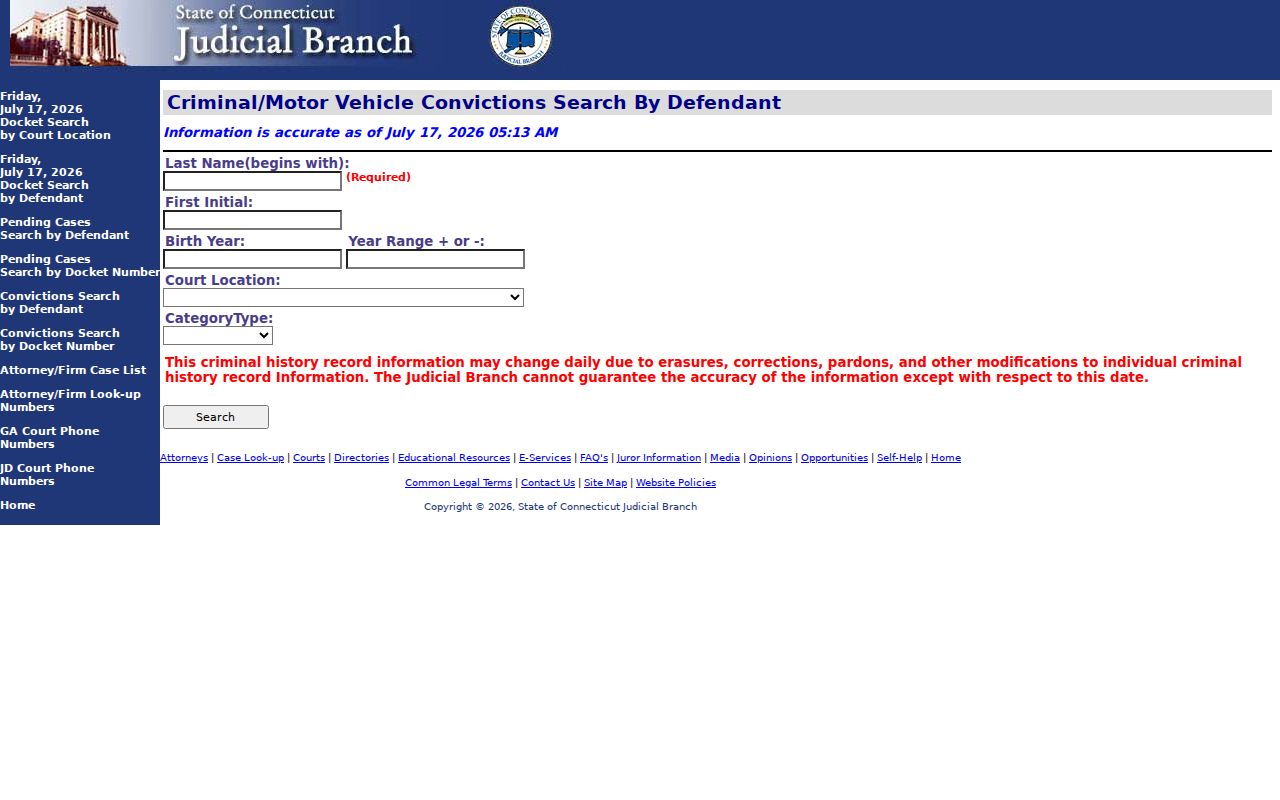
A clean pending result does not rule out a past disposition. Likewise, a disposed search does not reveal a case that remains open. Search spellings carefully, compare the venue, and use an exact docket whenever available.
Inside a Stratford Town Case File
A public result provides an index into the case, while the clerk file may hold more public documents. The filed charge can differ from the arresting officer's initial charge. Read each count through its plea and disposition before describing an outcome. For an authoritative copy, identify the exact item needed, such as the information, judgment, disposition, or transcript.
| Case Number & Court | Identifies the file and the Superior Court location responsible for it. |
|---|---|
| Charging Document | States the charge pursued in court and the cited Connecticut statute. |
| Docket Entries | Lists public events, appearances, motions, and other case activity. |
| Hearing Dates | Shows past events and the next scheduled event for a pending matter. |
| Disposition & Judgment | Records the outcome for each count, including dismissal, nolle, acquittal, or conviction. |
| Sentence & Conditions | May show incarceration, suspended execution, probation, and financial obligations. |
Decode a Stratford Criminal Docket
Connecticut's docket search does not treat the identifier as one loose string. It divides the number into location, case type, year, unique number, and suffix controls. A Stratford criminal docket commonly follows the structural pattern F02B-CRYY-NNNNNNN-S. The type menu can include CR, MV, CI, and MI. The official victim guide describes a seven-digit unique number after the location, type, and two-digit case year.
- F02B
- The location code associated with Bridgeport G.A. No. 2.
- CR
- The criminal case-type code.
- S
- The suffix for an original case.
- T or digits
- Suffixes that can reflect a transfer or later related file.
- A
- A suffix that can identify a severed matter.
An incomplete or mistyped segment can make a valid docket look absent. Check every part before switching to a name search or calling the clerk.
How a Criminal Case Moves
A Stratford incident may begin with an arrest or summons, but the prosecutor's review controls what enters the court record. The accused then appears, enters a plea, and proceeds through conferences and motions. Resolution may come through diversion, a plea, trial, dismissal, nolle, or acquittal. A conviction then reaches sentencing and may later produce an appeal or probation-violation docket.
Case flow: Charges Filed › Arraignment › Pretrial › Plea or Trial › Disposition › Sentencing
The sequence explains why an arrest log and final court case can tell different stories. Use the disposition, not the first police charge, when stating how the matter ended.
Sentence fields also need close reading. A term of incarceration may be followed by an amount whose execution is suspended, then a period of probation. That is not the same as a wholly unsuspended jail term. Financial amounts and later probation events can appear beside the judgment, so record each component instead of reducing the result to one phrase.
Get a Stratford Certified Disposition
Online information is convenient, but the Judicial Branch cautions that it is not the official record. Ask the clerk for a certified disposition when proof of the court's action is needed for personal record correction, pardon work, or another lawful purpose. Supply the case name, complete docket, court location, and desired document. The 2026 Judicial Directory lists ordinary copies at $1 per page, certification under seal at $2, a certified judgment file at $25, and a noncertified judgment file at $15. Current schedules control at the time of order.
The Judicial Branch reports that centralized retrieval generally takes one to two business days. Email delivery may be free when file size permits, while pickup and certification can trigger the stated charges. Some access requires identification.
Case Record Access & Restrictions
Connecticut court records are publicly accessible only within legal limits. Erased cases do not appear in public lookup. Juvenile matters, sealed files, victim and minor identifiers, full dates of birth, Social Security numbers, and information protected by court order are also withheld or redacted. A missing result can therefore reflect erasure, restricted access, a spelling mismatch, the wrong search mode, a transfer, or an older file that is not web-visible.
The Connecticut erasure statute covers qualifying dismissals, acquittals, nolles under its timing rules, and eligible Clean Slate records. The Connecticut Practice Book also governs judicial access and sealing. Ask the clerk whether a public file exists if a known case does not appear, but do not expect staff to reveal erased or protected material.
A nolle is a prosecutor's decision not to continue a charge at that point; it is not the same label as a dismissal or acquittal. Each outcome has its own docket meaning and erasure timing. When reviewing a personal record, copy the exact disposition and date for every count. That detail helps the clerk, SPBI, or Clean Slate unit trace a mismatch without treating an arrest label as the final result.
Stratford State Court or PACER
Connecticut's state lookup and the federal PACER system cover different courts. Most Stratford prosecutions appear in Superior Court. A federal prosecution in the U.S. District Court for the District of Connecticut will not appear there. PACER requires registration and applies the federal judiciary's current per-page policy, including its current low-usage waiver rules.
Search the state docket when the matter began with Stratford Police and proceeded through G.A. No. 2 or Fairfield JD. Use PACER only when the case is federal. The FBI Identity History Summary is a separate subject-only identity record, and the federal Bureau of Prisons locator concerns federal custody. Neither replaces a Connecticut Superior Court disposition.